
Introduction
Are your solar inverters tripping unexpectedly? Is your CNC machine or PLC system producing erratic results? Are diagnostic readings in your medical testing lab inconsistent? In many cases, the root cause is the same: an abnormal Earth-to-Neutral (E-N) voltage.
This guide explains why Earth-to-Neutral voltage problems occur, how to systematically diagnose them, and what steps resolve them — based on field-tested electrical troubleshooting practices.
What Is Earth-to-Neutral Voltage and Why Does It Matter?
In a healthy electrical system, the voltage between the Earth (ground) wire and the Neutral wire should be close to zero. When this Earth-to-Neutral voltage exceeds 3 volts, sensitive electronic equipment can begin to malfunction. Common symptoms include:
- Solar inverters tripping repeatedly or failing to save configuration settings
- CNC machines and PLC-controlled systems behaving erratically or producing inconsistent output
- Medical testing equipment in laboratories returning unreliable or inaccurate results
Important Clarification: It’s a Neutral Fault, Not an Earthing Fault
One of the most common misconceptions in the field is assuming that a measurable Neutral-to-Earth voltage means the earthing system is faulty. In reality, this almost always indicates a fault on the Neutral side of the circuit, not the Earth side. Misdiagnosing this can lead to unnecessary (and ineffective) earthing rework, when the real fault lies upstream in the neutral path.
Step-by-Step Troubleshooting Process
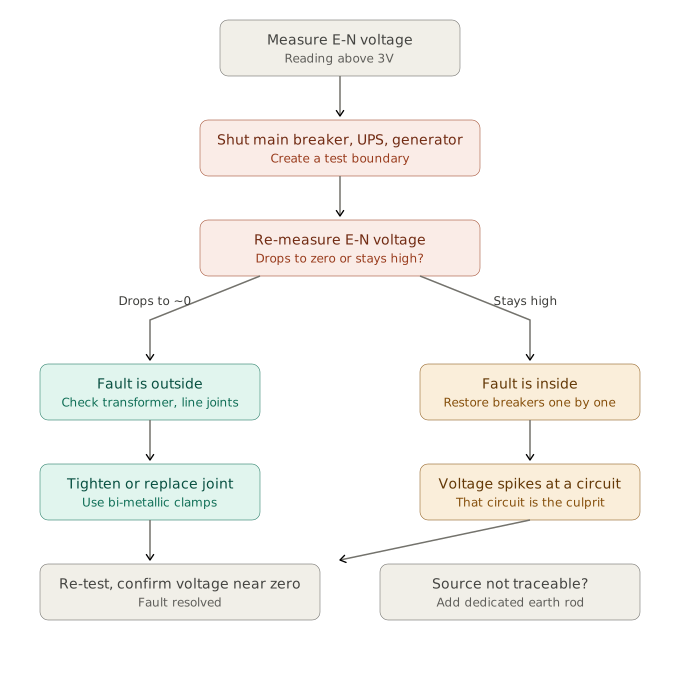
To locate the source of an Earth-to-Neutral fault, electricians create a “boundary” test to narrow down whether the issue originates inside or outside the premises.
Step 1: Determine the Scope — Inside vs. Outside
- Switch off the main breaker, along with any internal backup power sources such as UPS units or generators.
- Re-measure the Earth-to-Neutral voltage.
- If the voltage drops to near zero, the fault is located outside the premises — typically on the utility’s distribution network.
Step 2: If the Fault Is Outside (Approximately 99% of Cases)
- Inspect transformer joints: The most frequent culprit is a loose or oxidized connection at the transformer’s neutral terminal.
- Check distribution line joints: Ensure all connections along the line are clean and properly tightened.
- Watch for aluminum-to-copper connections: These require proper bi-metallic clamps to prevent galvanic corrosion, which gradually increases resistance and voltage leakage over time.
- Call a qualified line technician: High-voltage utility connections should only be inspected and tightened by a trained professional, for both safety and reliability.
Step 3: If the Fault Is Inside the Premises
- Restore breakers one at a time, measuring the Earth-to-Neutral voltage after each step.
- The circuit or machine responsible for the fault will be the one where voltage spikes upon activation.
- In large industrial facilities where the exact source is difficult to isolate, installing an additional dedicated earth rod can help “pull” the neutral voltage back down toward zero as a practical mitigation.
Why This Matters for Solar PV Systems
Solar inverters are particularly sensitive to Earth-to-Neutral voltage anomalies because of their grounding and isolation requirements. An unresolved neutral fault upstream can cause recurring inverter trips that are often mistaken for inverter hardware faults — leading to unnecessary equipment replacement when the actual fix is a proper earthing and neutral inspection.
Key Takeaways
- Earth-to-Neutral voltage above 3V can disrupt sensitive electronics.
- A Neutral-Earth voltage reading points to a Neutral fault, not a bad earth.
- Most faults (around 99%) originate outside the premises, typically at transformer or distribution joints.
- Loose or corroded connections — especially aluminum-to-copper joints — are the most common root cause.
- Dedicated earth rods can mitigate persistent faults in complex industrial setups when the exact source cannot be isolated.
Conclusion
The majority of Earth-to-Neutral voltage problems trace back to simple, preventable issues — loose connections, oxidized joints, or improper aluminum-to-copper terminations at the utility level. A systematic inside-vs-outside boundary test, followed by inspection of transformer and distribution joints, resolves most cases without complex internal rewiring.
If you’re experiencing unexplained solar inverter trips, CNC/PLC errors, or unreliable equipment readings, the underlying cause may be an Earth-to-Neutral voltage fault rather than a problem with your equipment itself.
Need Professional Earthing Diagnostics?
Unicorn Energy Systems is Pakistan’s first dedicated earthing chemicals manufacturer, based in Lahore, specializing in industrial and solar earthing solutions, lightning protection, and solar PV systems. If you suspect a Neutral or Earth fault is affecting your solar inverter, CNC equipment, or lab instruments, our engineering team can perform a complete diagnostic and recommend a certified earthing solution.
Contact Unicorn Energy Systems for a professional earthing assessment.
Q: What does it mean if there is voltage between neutral and earth?
A: It indicates a neutral fault, not an earthing fault.
Q: How much Earth-to-Neutral voltage is dangerous for electronics?
A: Above 3 volts, sensitive electronics like solar inverters and PLCs commonly malfunction.
Q: Can a bad neutral connection damage a solar inverter?
A: It can cause repeated tripping and failure to retain settings, often mistaken for inverter hardware faults