
Introduction
A lightning strike on an unprotected solar installation in Lahore recently caused extensive damage — to the building’s concrete roof, internal walls, household wiring, and the solar inverter itself. This real-world incident is a stark reminder that lightning protection is not a luxury add-on for solar power systems in Pakistan; it is a core engineering requirement.
At Unicorn Energy Systems, we documented this case in detail because it illustrates several mistakes that are alarmingly common across the solar industry — mistakes that put both property and lives at risk.
What Happened: The Incident
The lightning strike hit a solar structure that had no proper lightning protection in place. Instead of being safely intercepted and routed to ground, the surge of current found its own path — straight through the concrete roof. From there, it traveled through the building’s walls and eventually reached the home’s neutral wiring, spreading the damage well beyond the rooftop array.
This is the fundamental physics of lightning: it always seeks the fastest, lowest-resistance path to the ground. If a building doesn’t provide that path intentionally — through a properly designed lightning protection system — lightning will create its own path, often through structural concrete, wiring, and anything else in its way.
Why the System Failed
In this case, the absence of a correctly engineered lightning arrester meant there was no controlled discharge path. The electrical surge traveled into the home’s internal systems and caused severe damage to:
- Household appliances connected to the electrical network
- The solar inverter, which bore the brunt of the surge
- Structural elements of the building, including walls and roof concrete
This is a textbook example of what happens when a solar installation is treated as just “panels and an inverter” rather than a complete, protected electrical system.
Common Misconceptions That Leave Homes Unprotected
One of the most important points from this case study is addressing the excuses customers (and sometimes installers) use to skip lightning protection:
- “There’s a water tank nearby, it will attract the lightning instead.”
- “There’s a mobile tower close by, that should protect us.”
- “We’re near transmission lines, so we’re probably already covered.”
None of these assumptions hold up to engineering scrutiny. A nearby tall structure only offers protection if your building falls within its calculated protection radius — a specific, measurable zone determined by the structure’s height and applicable lightning protection standards. Without that calculation, assuming you’re “probably fine” is a gamble with your property and safety.
Where the Responsibility Lies
This incident highlights a shared responsibility problem in the solar industry:
- Customers often try to cut costs by skipping lightning arresters, surge protection devices, or proper earthing — treating them as unnecessary extras.
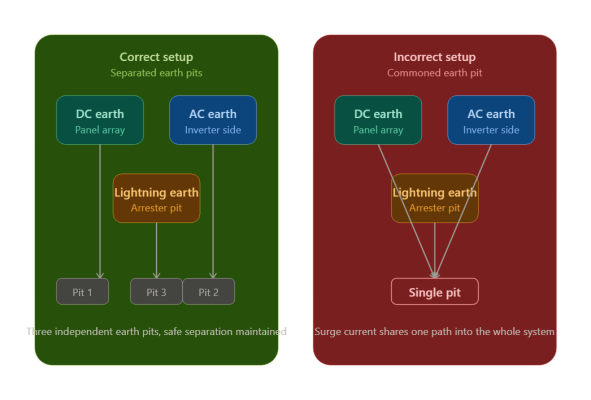
- Solar installation companies sometimes enable this by installing inadequate or improperly designed earthing systems, where AC earthing, DC earthing, and lightning protection earthing are incorrectly bonded together (commoned) instead of being separated according to proper engineering practice.
Both shortcuts can — and do — lead to incidents exactly like the one in this case study.
Engineering Recommendations: What a Proper Solar System Actually Needs
A safe, complete solar installation includes:
- A properly designed and positioned lightning arrester, sized and placed according to the structure’s protection radius requirements
- Dedicated, correctly separated earthing systems for AC, DC, and lightning protection — not a single shared (commoned) earth pit
- Surge protection devices (SPDs) and breakers rated for the system’s voltage and fault conditions
- Site-specific risk assessment rather than assumptions based on nearby structures
These components are not “forced expenses” added to inflate a quotation. They are fundamental parts of a complete, functioning solar system — just as essential as the panels and inverter themselves.
Conclusion
This Lahore case study is a clear demonstration of what happens when lightning protection and proper earthing are treated as optional. The cost of skipping these components is almost always far higher than the cost of installing them correctly in the first place — in this case, a damaged roof, walls, wiring, and a destroyed inverter.
As Pakistan’s first earthing chemicals manufacturer, Unicorn Energy Systems designs solar installations with lightning protection and proper earthing built in from day one — not bolted on as an afterthought.
Considering a solar installation, or worried your existing system isn’t properly protected? Contact Unicorn Energy Systems for a site assessment and protection radius calculation.
Related Videos
- How to Calculate Lightning Protection Radius for Solar Installations
- AC vs DC vs Lightning Earthing: Why They Must Be Separated
- Choosing the Right Earthing Chemicals for Pakistani Soil Conditions